
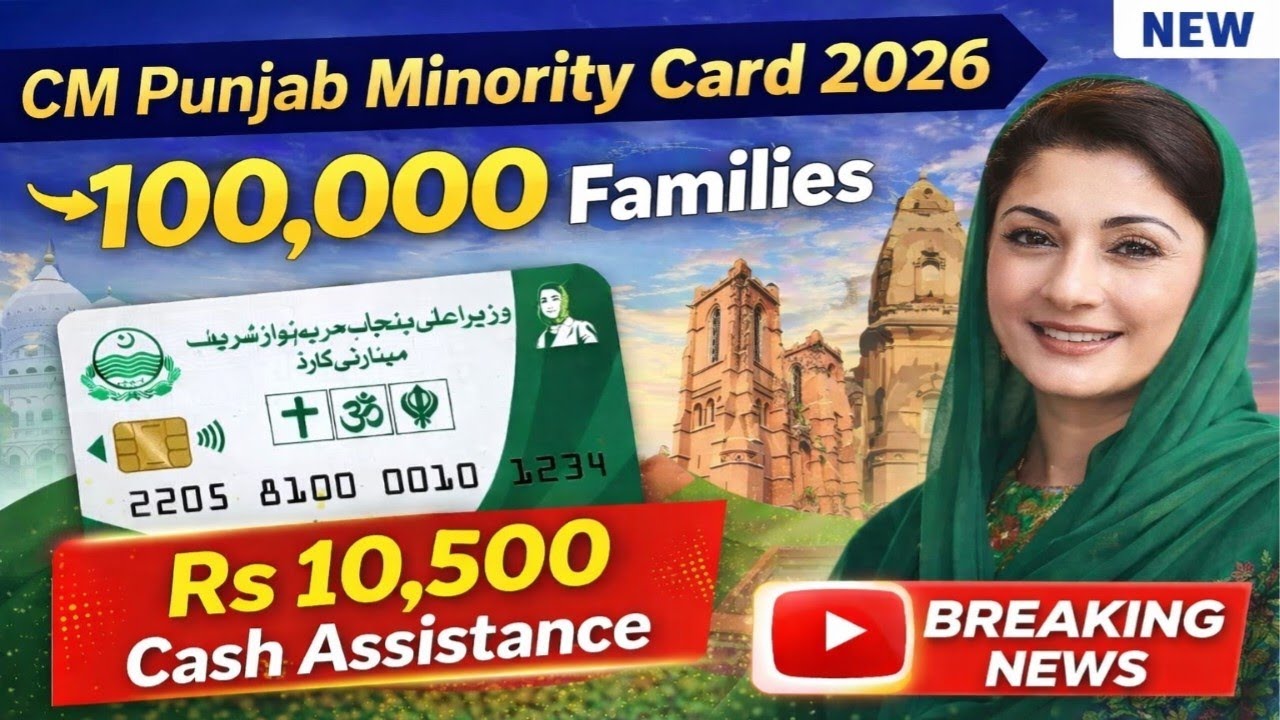
CM Punjab Minority Card 2026: Imagine a government program that does more than just offer temporary relief—one that recognizes your identity, affirms your dignity, and provides consistent, predictable support to help your family not just survive, but thrive. For thousands of minority families across Punjab, this vision has become a tangible reality with the launch of the CM Punjab Minority Card 2026.
In a landmark move toward inclusive development, the Government of Punjab, under the dynamic leadership of Chief Minister Maryam Nawaz Sharif, has unveiled a significantly expanded and enhanced version of this transformative social welfare initiative. Building upon the solid foundation of earlier phases, the 2026 program represents more than just a cash transfer scheme—it is a cornerstone of social justice, a tool for economic inclusion, and a powerful statement of belonging for Punjab’s diverse religious communities.
This comprehensive guide, spanning over 3,000 words, will serve as your definitive resource on every aspect of the scheme—from its philosophical underpinnings to the practical steps of registration, fund access, and troubleshooting. We will delve deep into the eligibility criteria, demystify the registration process, explore the broader impact of the benefits, and provide actionable solutions to common challenges. Whether you are a potential applicant, a community leader, or simply an interested observer of progressive social policy, this guide aims to provide unparalleled value and clarity on a program that is setting new standards for targeted welfare in Pakistan.
Program Overview and Objectives – Beyond Financial Assistance
| Feature | Details |
| Amount | Rs. 10,500 (Per Quarter) |
| Target | 75,000 Households |
| Bank Partner | Bank of Punjab (BOP) |
| Income Threshold | Up to Rs. 60,000 monthly |
| Official Helpline | 1040 (HR&MA Department) |
The Vision Behind the Initiative
The CM Punjab Minority Card 2026 is administered by the Human Rights & Minority Affairs Department with a clear, multi-dimensional vision that extends far beyond simple financial disbursement. At its core, the program is designed to achieve several interconnected objectives:
- Poverty Alleviation Through Direct Support: The primary aim is to provide immediate, quarterly financial assistance to the most economically vulnerable families within minority communities, helping them meet basic needs without resorting to debt or detrimental coping mechanisms.
- Promotion of Social Inclusion and Dignity: By specifically designing a program for religious minorities, the government acknowledges historical marginalization and actively works to foster a sense of equal citizenship and social cohesion. The card itself becomes a symbol of state recognition and belonging.
- Strengthening the Social Safety Net: This initiative is a key component of Punjab’s broader “Social Protection Framework,” which includes the Kisan Card, the Roshan Gharana Solar Scheme, and health insurance programs. Together, they form an interlocking system designed to catch families before they fall into deeper poverty.
- Encouraging Financial Inclusion: By delivering funds through a formal banking partner—the Bank of Punjab (BOP)—the program brings beneficiaries into the formal financial system. This access to a bank account and ATM card can be a first step toward saving, building financial literacy, and accessing other services.
- Data-Driven and Transparent Governance: The program leverages the National Socio-Economic Registry (NSER) and NADRA’s biometric verification to ensure aid is distributed based on objective need (the PMT score), minimizing human discretion and the potential for corruption or political favoritism.
Key Enhancements in the 2026 Expansion
The 2026 iteration marks a significant evolution from previous phases:
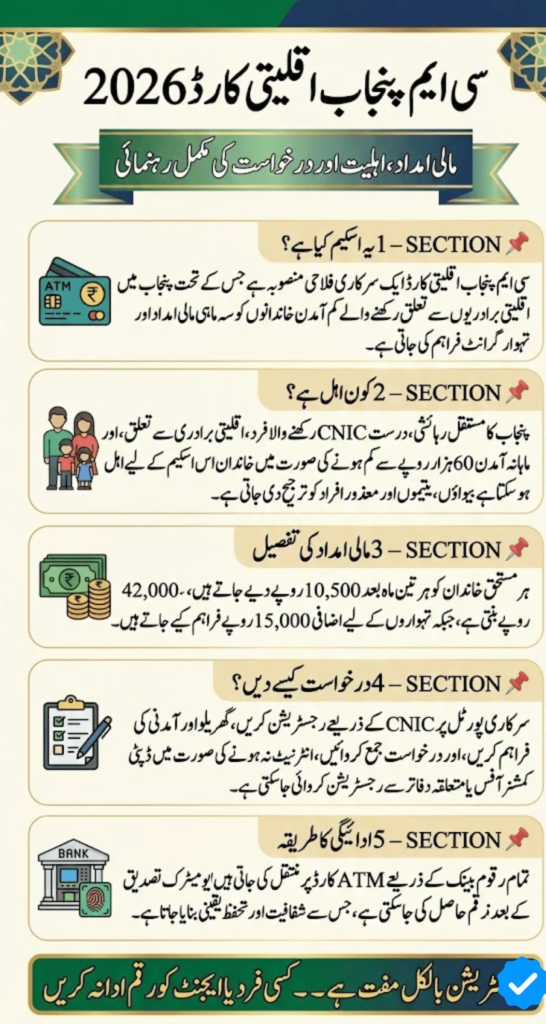
- Scale: The number of beneficiary families has been increased from 75,000 to 100,000, dramatically expanding the program’s reach.
- Assistance Amount: The quarterly grant has been standardized and potentially increased to Rs. 10,500 per family, providing more substantial support against inflation.
- Process Streamlining: The integration of a dedicated online portal (
mcard.punjab.gov.pk) and a centralized helpline (1040) reflects a commitment to user-friendly, accessible service delivery.
Required Documents for Registration
Applicants should prepare the following documents to avoid rejection:
| Document | Purpose |
|---|---|
| CNIC (Smart Card) | Identity verification |
| Punjab Domicile | Residency proof |
| Income Proof / Affidavit | Financial assessment |
| Disability Certificate | If applicable |
| Death Certificate | For widows (if applicable) |
Accurate documentation speeds up approval and payment release.
Eligibility Criteria for CM Punjab Minority Card 2026 – Who Qualifies?
The eligibility framework is meticulously designed to ensure resources are directed to those with the greatest need while maintaining administrative integrity. Meeting all of the following criteria is mandatory:
1. Religious and Residential Identity
- Community Affiliation: The applicant must belong to a constitutionally recognized religious minority community in Pakistan. This explicitly includes Christians, Hindus, Sikhs, Parsis, Baháʼís, Buddhists, and other notified groups. The primary applicant’s CNIC must reflect this religious affiliation.
- Domicile and Residence: The applicant must be a permanent resident of Punjab province. Temporary residents or those with domicile from other provinces are not eligible. Proof of residence may be cross-verified through utility bills or local government records.
2. Socio-Economic Status (The Critical PMT Score)
- Poverty Means Test (PMT) Score ≤ 45: This is the program’s most crucial technical filter. The PMT is a proxy means test formula used by the Benazir Income Support Programme (BISP) and the NSER. It uses survey data on household assets, income sources, living conditions, and demographic makeup to estimate economic status without relying solely on declared income.
- A score of 45 or lower categorizes a household as “poor” or “very poor” and is the cutoff for this scheme.
- The score is calculated automatically from the NSER database; applicants do not choose their score.
3. Household and Beneficiary Status
- Head of the Family: Applications must be submitted by the recognized head of the household, typically the primary income earner or senior-most member.
- One Benefit Per Family: The assistance is per household, not per individual. Only one member per family unit can apply and receive funds.
- Non-Beneficiary of Conflicting Schemes: The applicant’s household must not be receiving direct cash assistance from other major provincial or federal cash transfer programs that serve a similar purpose, such as the Punjab Social Protection Authority (PSPA) core program or the BISP Kafaalat program. This prevents duplication of benefits.
4. Documentation and Technical Requirements
- Valid Biometric CNIC: A computerised National Identity Card from NADRA is non-negotiable. It must be current, not expired, and the biometric data (fingerprints) must be registered with NADRA.
- Registered Mobile Number: The applicant must have an active mobile number that is biometrically verified and linked to their CNIC. All official communication, including approval SMS and transaction alerts, will be sent to this number.
Special Note for Previous Beneficiaries: Families who were part of the first 75,000 beneficiaries under earlier phases of the CM Minority Card do not need to reapply. Their enrollment has been carried forward, and they will continue to receive payments seamlessly. Their responsibility is to ensure their registered mobile number and bank details are active.
The Registration Process – A Step-by-Step Walkthrough
The government has established a defined application window for the new 100,000 beneficiaries. For the 2026 cycle, online registration opened on January 26, 2026, and is scheduled to close on February 15, 2026. It is imperative to apply within this period.
Pre-Registration Checklist
Before clicking the apply button, ensure you have the following:
- Your original CNIC and a note of its number.
- An active mobile number that is biometrically linked to your CNIC.
- Knowledge of your basic household information (number of family members, etc.).
- A stable internet connection.
Online Registration for Minority Card 2026: The Detailed Procedure
The entire process is designed to be completed from home or a community center with internet access.
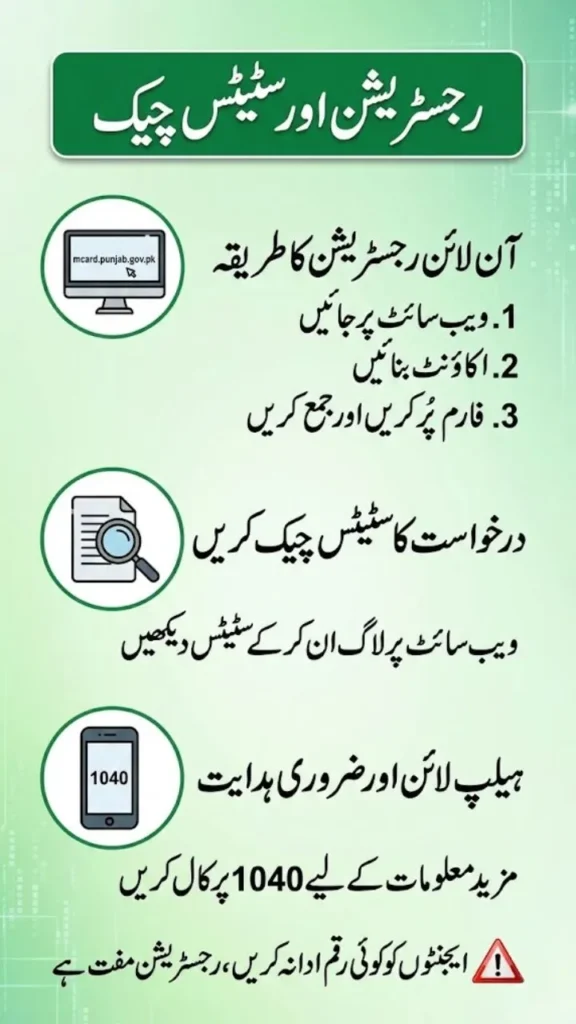
Step 1: Access the Official Portal
Open a web browser on your computer or smartphone and navigate to the official website: https://mcard.punjab.gov.pk. Be extremely cautious of fake or lookalike websites. The official Punjab government portal will have a .gov.pk domain.
Step 2: Locate and Initiate the Application
On the website’s homepage, look for a prominent banner, button, or menu option labeled “CM Minority Card,” “Apply Online,” or “Registration 2026.” Clicking this will lead you to the application portal.
Step 3: Fill the Digital Application Form
You will be presented with a secure online form. Fields will typically include:
- Applicant’s CNIC Number (Enter without dashes).
- Registered Mobile Number (You will receive an OTP on this number for verification).
- Personal Details: Name (as per CNIC), Father’s/Husband’s Name, Date of Birth.
- Household Details: District, Tehsil, Union Council, Complete Address, Number of Family Members.
- Religious Affiliation (often auto-filled from CNIC data).
- Declaration: A mandatory checkbox confirming that the information provided is correct and that you meet the eligibility criteria.
Step 4: Submission and Acknowledgement
After carefully reviewing all entered information, submit the form. Upon successful submission, the system will generate a unique Application ID or Tracking Number. This number is crucial. Save it by taking a screenshot, writing it down, or saving the confirmation page. You will use it to track your application status.
Step 5: The Verification Black Box
Once submitted, your application enters the verification phase. This is an automated but critical backend process where:
- Your CNIC details are cross-checked with NADRA for validity and religious affiliation.
- Your household’s PMT score is pulled from the NSER/BISP database.
- A check is run to see if any family member is already a beneficiary of this or other conflicting schemes.
- This process can take several days to a few weeks. No action is required from you during this period.
What If You Need Offline Help?
The government acknowledges the digital divide. If you face difficulties:
- Helpline: Call the Punjab Government Citizen’s Portal helpline at 1040. Operators can guide you through the process, clarify doubts, and escalate technical issues.
- Facilitation Centers: While primarily online, the Human Rights & Minority Affairs Department may set up temporary facilitation desks in district offices or minority-populated areas during the registration period. Inquire about these through the helpline or local community leaders.
The Benefits and Package Contents – Understanding the Impact
The financial benefit of Rs. 10,500 per quarter is the most direct and visible output of the program. However, its real value lies in how it empowers families to make choices that enhance their stability and well-being.
A Deep Dive into the Financial Grant
- Annual Value: Rs. 42,000 per year (10,500 x 4). For a family hovering around the poverty line, this sum can represent a significant percentage of their annual cash income.
- Predictability: Unlike sporadic aid or zakat, this quarterly payment is predictable. Families can plan their expenses, knowing when the next installment will arrive. This predictability reduces stress and allows for better financial management.
- Direct Transfer: The money is deposited directly into a bank account linked to the Minority Card, following the successful “BISP model.” This eliminates leakages and ensures the full amount reaches the beneficiary.
The Multi-Dimensional Impact on Households
Field studies and surveys from similar cash transfer programs reveal how families typically allocate these funds:
| Expenditure Category | Typical Use Cases | Long-Term Impact |
|---|---|---|
| Food & Nutrition | Purchasing more or higher-quality staples (wheat, rice, pulses), milk for children, protein sources (eggs, meat). | Improves household food security, reduces malnutrition, especially in children and pregnant women. |
| Education | Paying school fees, purchasing uniforms, books, and stationery, covering transportation costs. | Reduces school dropout rates, particularly for girls. Increases human capital for the next generation. |
| Healthcare | Paying for doctor consultations, essential medicines, laboratory tests, or saving for medical emergencies. | Prevents families from falling into poverty due to health shocks. Encourages preventative care. |
| Debt Management | Paying down high-interest loans from informal lenders, avoiding new debt for daily needs. | Reduces the burden of debt-servicing, freeing up future income for productive use. |
| Essential Utilities | Ensuring uninterrupted payment of electricity, gas, and water bills. | Maintains a dignified and stable living environment. |
Beyond Cash: The Intangible Benefits
- Agency and Dignity: Beneficiaries consistently report that having their own ATM card and the freedom to decide how to spend the money restores a sense of control and dignity, as opposed to receiving in-kind aid.
- Social Standing: The card can enhance the family’s standing within their community, as it is seen as a legitimate and formal recognition of their status by the state.
- Financial Identity: For many, especially women beneficiaries, this may be their first formal banking relationship, creating a financial identity that can be built upon.
How to Check Status and Withdraw Funds
The Status Check Process
After the application window closes, the verification process begins. You can track your application through the following steps:
- Revisit the official portal:
mcard.punjab.gov.pk. - Look for the “Check Application Status” or “Track Your Card” option.
- Enter your CNIC number and the Application ID/Tracking Number you received upon submission.
- The portal will display one of the following statuses:
- Received/Under Process: Your application is in the queue for verification.
- Sent for Verification/Under Review: Your details are being checked with NADRA and BISP.
- Approved: Congratulations! Your eligibility is confirmed. The message may indicate the expected card dispatch or activation timeline.
- Rejected: This will often be accompanied by a brief reason (e.g., “PMT Score above threshold,” “Duplicate Application,” “CNIC not verified”).
The Withdrawal Process: Accessing Your Funds
Once approved, you will be enrolled with the Bank of Punjab (BOP). The process is designed for security and ease:
Phase 1: Receiving the Card and PIN
- You will receive an official SMS from BOP or the scheme authorities informing you that your CM Punjab Minority Card is ready.
- You may be directed to collect the physical ATM card from a designated BOP branch in your district, or it may be delivered via registered postal service in some cases.
- A separate, secure PIN mailer will be sent to your registered address or provided at the time of card collection. Never share this PIN with anyone.
Phase 2: The First Cash Withdrawal
- Notification: You will receive an SMS alert as soon as the quarterly installment (Rs. 10,500) is credited to your card account.
- Locate an ATM: Go to any Bank of Punjab (BOP) ATM. A network locator is usually available on the BOP website or via the helpline.
- Withdraw: Insert your card, enter your secret PIN, select “Cash Withdrawal,” and choose the amount (you can withdraw the full sum or part of it). The ATM will dispense the cash and provide a receipt. Always take the receipt.
- Biometric Verification (Alternative): At some designated payment points or specific ATMs, you may be able to withdraw using your fingerprint biometrics linked to your CNIC, instead of a PIN.
Common Issues & Proactive Solutions
Despite streamlined processes, applicants may face hurdles. Here’s a detailed troubleshooting guide:
| Common Issue | Likely Cause | Recommended Solution |
|---|---|---|
| “PMT Score Ineligible” / “Score > 45” | Your household’s data in the NSER suggests assets or income sources that place you above the cutoff. This data might be outdated or incorrect. | Visit your nearest BISP/NSER Tehsil Office. Request a re-survey or correction of your household’s socio-economic data. Provide accurate information. This can lower your score for future cycles. |
| “CNIC Not Verified” / “Data Mismatch” | Discrepancy between your application info and NADRA records (e.g., outdated address, name spelling). | Visit your nearest NADRA Registration Center (NRC). Apply for an update/correction of your CNIC details. Ensure your religious affiliation is correctly recorded. |
| “Mobile Number Not Linked” / No SMS Received | Your phone number is not biometrically verified with your CNIC. | Go to the franchise or customer service center of your mobile network provider (Jazz, Zong, etc.) with your original CNIC. Complete the biometric re-verification process to link your number. |
| “Duplicate Application” Error | You or a family member has already applied, or your data matches an existing beneficiary. | Call helpline 1040 to clarify. If you applied twice by mistake, request they cancel the duplicate. If it’s a case of identity confusion, you may need to visit a facilitation center with your CNIC. |
| Card Received but No Funds | 1. The quarterly payment cycle hasn’t credited funds yet. 2. There’s a technical delay from the bank. | 1. Be patient; payments are made in quarterly batches (e.g., Jan-Mar, Apr-Jun). 2. Call the BOP helpline for Minority Card (provided with your card) or visit your card-issuing branch with your CNIC and card. |
| Forgotten PIN or Card Blocked | Multiple incorrect PIN entries at the ATM. | Do not try again. Immediately call the BOP helpline to request a PIN reset or to unblock the card. You will likely need to visit your card-issuing branch with your CNIC for a secure reset. |
Frequently Asked Questions (FAQs) – Addressing Your Concerns
Who exactly can apply for the CM Punjab Minority Card?
A head of family belonging to a notified religious minority (Christian, Hindu, Sikh, etc.), holding a valid Punjab domicile and CNIC, with a PMT score of 45 or less, and not receiving similar cash aid from BISP Kafaalat or PSPA.
How much money is actually given, and how often?
Each eligible family receives Rs. 10,500 every three months (quarterly), amounting to Rs. 42,000 per calendar year.
Is the registration truly open right now in 2026?
The registration for the new batch of 100,000 beneficiaries for the 2026 program opened on January 26, 2026, and will close on February 15, 2026. Always verify this on the official portal or via helpline 1040, as dates are subject to change based on government notification.
How can I find out or improve my PMT score?
You cannot “get” a score on demand; it is generated from the NSER database. To know your score or update your data:
SMS Inquiry: Send your 13-digit CNIC number (without dashes) to 8171. You may receive your score if registered.
Visit in Person: Go to the nearest BISP tehsil office or an NSER registration center with your CNIC. You can request your score and initiate a re-survey if your circumstances have worsened (e.g., loss of job, death of breadwinner, major illness).
Is there any hidden fee for registration or processing?
Absolutely not. The entire process—application, verification, card issuance—is free of charge. Any individual, agent, or middleman demanding money for registration, expedited processing, or guarantee of approval is committing fraud. Report such individuals immediately to helpline 1040.
What is the official helpline number for queries and complaints?
The primary contact is the Punjab Government Citizens’ Portal Helpline: 1040. Operatives should be able to handle queries about eligibility, process, and status. For bank-specific issues (card not working, PIN reset), you will need the dedicated helpline number provided by the Bank of Punjab with your card materials.
Who is eligible for the CM Punjab Minority Card 2026?
Permanent residents of Punjab belonging to recognized minority communities with low income qualify.
How much financial support is provided under this scheme?
Eligible families receive Rs. 10,500 quarterly and Rs. 15,000 as festival grants.
How can beneficiaries withdraw their money?
Funds can be withdrawn through Bank of Punjab ATMs using the debit card.
How many families will benefit from the scheme in 2026?
Around 75,000 minority families are targeted across Punjab.
Conclusion
The CM Punjab Minority Card 2026 is more than a welfare scheme; it is a sophisticated instrument of social policy that marries compassion with technology, dignity with efficiency. It represents a conscious effort to bridge the gap between marginalized communities and the state’s resources, fostering a more inclusive and equitable Punjab.
For eligible families, it offers a lifeline of predictable support that can cushion against shocks, enable better life choices, and slowly but steadily alter their economic trajectory. For the province, it invests in social stability and the human capital of all its citizens.
The success of such a program ultimately depends on two factors: the government’s commitment to transparent and efficient implementation, and the awareness and proactive engagement of the communities it aims to serve. This guide has aimed to empower you with the latter.
Now, the crucial question remains: Have you taken the first step to verify your family’s eligibility and ensure your data with NADRA and BISP is accurate and up-to-date? Your rightful access to this program of dignity may depend on it.