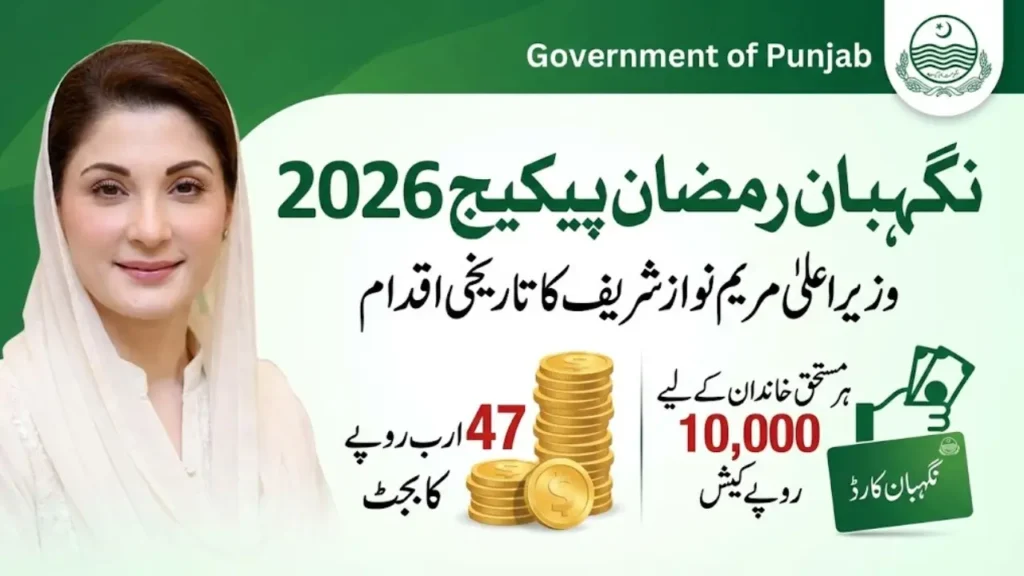
Ramzan Package 2026: Imagine the first evening of Ramadan 2026. The sun sets, the call to prayer echoes, and families gather to break their fast. For some, however, the Iftar table is worryingly bare, overshadowed by the silent strain of soaring prices for flour, ghee, and dates. The spiritual serenity of the month clashes with the harsh reality of inflation. This year, the Government of Punjab aims to bridge that painful gap with a historic intervention. Announcing the largest relief package in the province’s history, the Nigehban Ramzan Package 2026 is not just another subsidy program; it is a Rs. 47 billion commitment to dignity, direct support, and data-driven delivery for 4.2 million low-income families.
Gone are the days of chaotic distribution centers and generic ration bags. In a transformative shift, the 2026 package embraces a fully digital, transparent system centered on the Punjab Socio-Economic Registry (PSER) and a newly introduced Nigehban Ramzan Card. This guide is your comprehensive, step-by-step roadmap through this new landscape. We will demystify the eligibility criteria based on the PSER survey, detail all registration and verification channels, and explain precisely how to access and use the Rs. 10,000 in financial assistance. Our goal is to ensure that every eligible family in Punjab can navigate this process with confidence, securing the support they need to observe Ramadan with peace and devotion.
Program Overview and Objectives: A Paradigm Shift in Welfare
The Nigehban Ramzan Package 2026 represents a fundamental reimagining of how social safety nets are deployed during periods of peak need. With a staggering allocation of Rs. 47 billion, the program’s scale reflects the severity of the economic challenges faced by ordinary citizens. However, its true innovation lies not in its budget but in its design—moving from a paternalistic model of giving to an empowering model of enabling.
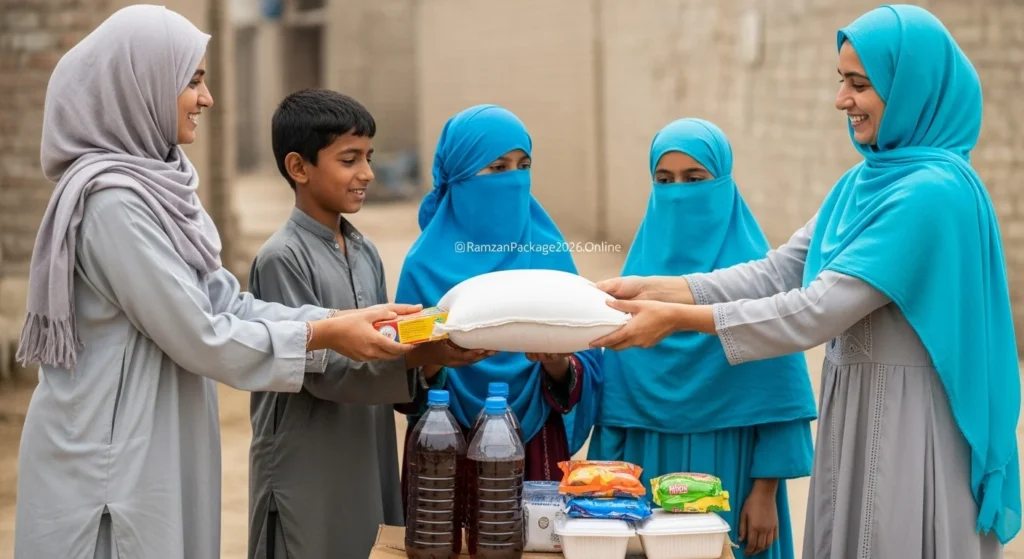
The core mechanism is the Nigehban Ramzan Card, a dedicated debit card pre-loaded with Rs. 10,000 for each eligible family. This shift from commodity-based aid to direct cash transfer is pivotal. It recognizes that a widow’s most pressing need may be an electricity bill, while a daily wage laborer’s priority is flour and lentils. The card restores choice and dignity, allowing families to act as the best judges of their own necessities. To ensure transparency and eliminate ghost beneficiaries, the entire program is anchored to the Punjab Socio-Economic Registry (PSER), a comprehensive database built through a province-wide door-to-door survey. This data-centric approach ensures help is targeted, fair, and verifiable.
- Beyond the Card: A Multi-Layered Safety Net: It is crucial to understand that the Nigehban Card is the centerpiece of a broader ecosystem of support. The Punjab government has simultaneously:
- Increased the subsidy amount for existing Rashan Card holders.
- Expanded the Sasta Bazars network, offering essential commodities at significantly reduced prices.
- Organized thousands of free Iftar Dastarkhwans across the province for travelers, students, and the needy.
- Instituted strict price control mechanisms (“Rate Lists“) on key Ramadan items at the utility store and market levels.
This multi-pronged strategy ensures that relief is not a one-time transaction but a sustained environment of support throughout the holy month.
| Aspect | Details |
|---|---|
| Program Name | Punjab Nigehban Ramzan Package 2026 (also known as Nigehban Ramadan Package; integrated with PSER, CM Rashan Card, and related relief schemes) |
| Launched By | Chief Minister Maryam Nawaz Sharif, Government of Punjab |
| Objective | Deliver cash assistance, essential rations/subsidized commodities, and support for Sehri/Iftar/Eid to ease inflation burden; ensure dignity with minimal hassle/queues; promote transparency via PSER targeting; prioritize vulnerable/low-income groups while minimizing duplication with federal programs like BISP |
| Target Beneficiaries | Approximately 4.2 million low-income/deserving families in Punjab (daily wagers, laborers, widows, disabled persons, etc.; benefiting nearly 1 crore individuals overall) |
| Budget Allocation | Rs 47 billion (the largest-ever such package; significant increase from previous years, like ~Rs 30 billion in 2025) |
| Key Benefits | – Rs 10,000 one-time cash assistance per eligible family – Free/subsidized ration bags (essentials like flour, oil, sugar, pulses) – Additional support via Nigehban Dastarkhwan (free iftar meals), Sasta Bazaars, and “Maryam ke Mehman” centers |
| Distribution Mechanism | – Door-to-door delivery of special Nigehban Cards (ATM-enabled via Bank of Punjab) – Cash withdrawal at Bank of Punjab ATMs or activation centers (136+ centers reported) – Purchases at designated bazaars/outlets; linked to CM Rashan Card for enhanced monthly support (increased to Rs 10,000 during Ramzan) |
| Official Portal / Registration | Primarily through Punjab Socio-Economic Registry (PSER) at pser.punjab.gov.pk for eligibility verification, updates, and registration; no separate dedicated Ramzan 2026 portal; PSER-based targeting ensures transparency |
| Helpline / Checks | Rs 47 billion (the largest-ever such package; significant increase from previous years like ~Rs 30 billion in 2025) |
Eligibility Criteria for Ramzan Package 2026: Are You in the Database?
The eligibility framework for the 2026 package is intentionally precise, designed to filter assistance to those with the greatest demonstrated need. The single most important factor is inclusion in the Punjab Socio-Economic Registry (PSER). Your family’s presence in this database, with verified and accurate information, is the gateway to all benefits.
The Central Role of the Punjab Socio-Economic Registry (PSER)
The PSER is not a new application but a census-like survey that recorded the socio-economic conditions of over 16 million households in Punjab. Teams visited homes to collect data on:
- Family composition and CNIC details of all members.
- Sources and level of household income.
- Employment status and profession.
- Assets, property, and living conditions.
- Special status (e.g., widow, disabled, elderly).
This data creates a “poverty score” and profile for each household. For the Nigehban Package, the government is using this profile to automatically identify qualifying families. If your household was surveyed, you are already in the system. Your task is not to apply, but to check your status.
Specific Eligibility Benchmarks
While the final selection algorithm uses the full PSER data profile, the primary published criteria are:
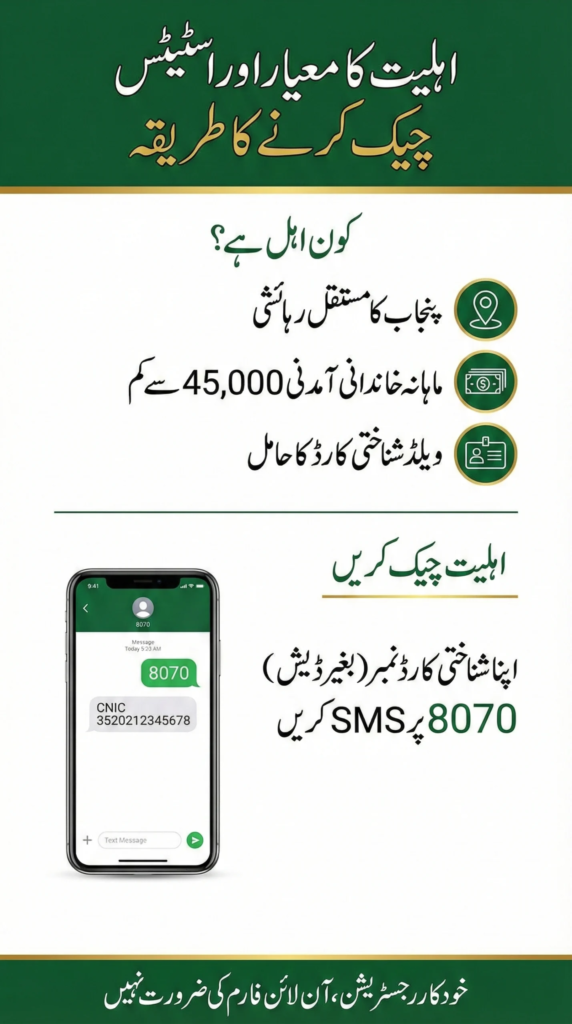
- Income Threshold: The monthly household income must be Rs. 45,000 or less. This is the primary financial cutoff.
- Residency: The family must be permanent residents of Punjab.
- Identity: The head of the household must possess a valid, verified Computerized National Identity Card (CNIC) from NADRA.
- Vulnerability Prioritization: Within the eligible income bracket, priority is given to:
- Widows and orphan-supporting families.
- Senior citizens with no stable income.
- Persons with Disabilities (PWDs).
- Daily wage earners (construction workers, street vendors, etc.).
- Existing beneficiaries of the Maryam Nawaz Rashan Raiyan or similar provincial support programs.
Critical Exclusions and Checks
The system is designed to prevent duplication and fraud. Families that may be excluded include those:
- Whose PSER data shows assets or income sources significantly above the threshold.
- Where multiple members of the same extended family (sharing the same address and economic unit) have separately been surveyed, causing duplication.
- Who are already receiving substantial direct cash transfers from other federal or provincial social protection programs (though some overlaps like the Rashan Card are managed).
- Where the CNIC information is invalid, expired, or mismatched with NADRA records.
Action Step: If you believe you meet the criteria but are unsure of your PSER status, your first action must be to check it. This leads us directly to the registration and verification process.
Registration Process of Ramzan Package 2026: Verification, Not Application
For the vast majority, there is no active “registration” for the 2026 package. The process is one of verification and status confirmation. The government has moved from an “application-based” model (which often benefits the most vocal or connected) to a “data-based identification” model.
Step 1: The Mandatory PSER Status Check
Before anything else, you must determine if your household is in the PSER and if your data is correct.
- Online Portal: Visit the official PSER website: https://pser.punjab.gov.pk. Look for a “Check Your Eligibility” or “Beneficiary Status” portal. You will need to enter the CNIC number of the head of the household.
- SMS Service (If Activated): While not confirmed for 2026, previous relief programs used shortcodes like 8171. Await an official announcement from the Punjab Government or the Bank of Punjab. A potential format could be: Send your CNIC number (without dashes) to 8123.
- Helpline: An official helpline number is likely to be announced. Keep an eye on official press releases from the Punjab Information Department.
Step 2: Addressing Data Gaps or Errors (“Registration” in the True Sense)
If your family was never surveyed or you find errors in your data (wrong income, missing family members), then you must actively get included or corrected.
Online Registration For Ramzan Package 2026
This is for a new entry into the PSER.
- Go to https://pser.punjab.gov.pk.
- Find and click on the option for “New Survey Registration” or “Get Registered.”
- You will be asked to input the head of household’s CNIC, after which a detailed digital form will open.
- Fill out every field with extreme care and honesty: Number of dependents, precise income from all sources, occupation, property details, etc. Any discrepancy with later verification will lead to disqualification.
- Submit the form. You will receive a tracking ID. A field team may then be dispatched to physically verify your home.
Offline Registration & Grievance Redressal
For those without internet access or with complex data issues.
- Visit Your Local Government Office: Go to your Tehsil Municipal Administration (TMA) office or the District Commissioner’s (DC) Office. Ask for the PSER Grievance Cell or the officer in charge of the Nigehban Package.
- Submit a Written Application: Explain clearly if you were missed in the survey or what specific data is incorrect (e.g., “Income listed as Rs. 60,000 is wrong; actual income is Rs. 35,000”).
- Provide Proof: Bring any supporting documents—utility bills in your name, salary slips, a letter from an employer, medical certificates for disability, etc.
- Request a Re-Survey: Ask for your household to be re-surveyed or your case re-evaluated. Get an official receipt or number for your complaint.
Important Note: The government has stated the door-to-door survey is 94% complete. Offline channels are now primarily for the remaining 6% and for correcting errors, not for mass new registration.
How to Withdraw Funds for the Ramzan Nigehban Package 2026
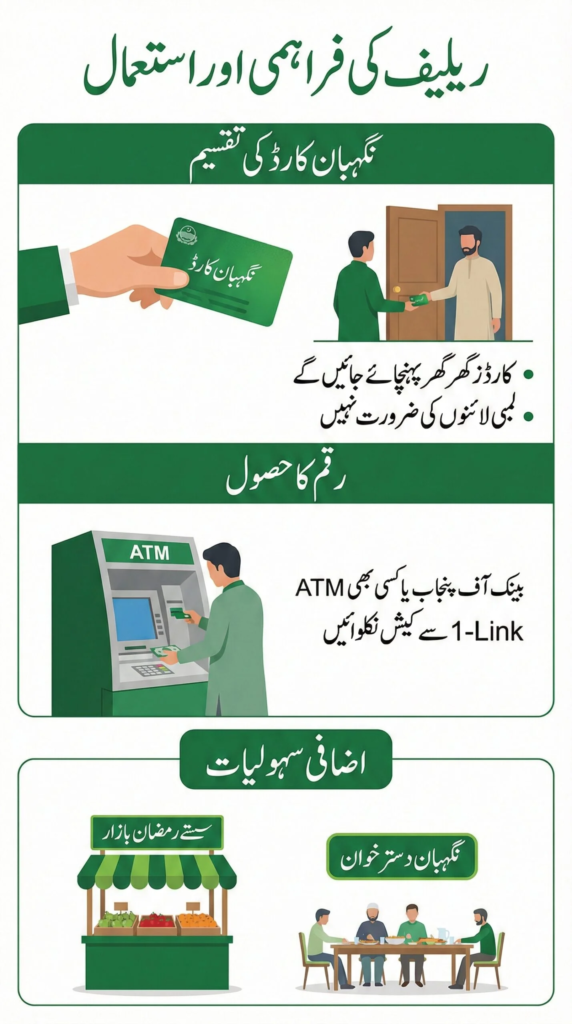
Once your family is identified as eligible, the physical Nigehban Ramzan Card will be delivered to your registered address by the district administration. This section provides a detailed, granular guide on what happens next.
1. Activate Your Nigehban Card (If Required)
Upon receipt, the card may be active. If not, activation is simple.
- SMS Activation: You might receive instructions to activate via SMS. This usually involves sending your CNIC number to a specific code.
- ATM Activation: Visit any Bank of Punjab (BOP) ATM. Insert the card, and you may be prompted to set your 4-digit PIN, which simultaneously activates it.
- Designated Centers: The government has set up 136 activation centers statewide. Visit the one in your district with your original CNIC and the registered mobile phone for verification.
2. Where and How to Withdraw Cash or Make Purchases
The Rs. 10,000 is electronically loaded onto the card. You have multiple access points:
- ATM Withdrawals:
- Bank of Punjab ATMs: This is the primary network. Use your card and PIN to withdraw cash in full orin parts.
- 1Link / MNET Network ATMs: The card should function at any ATM displaying the 1Link logo (which includes most major Pakistani banks), though a small transaction fee may apply from the host bank.
- Over-the-Counter (OTC) Withdrawals:
- Visit any Bank of Punjab branch. Present your card and original CNIC to a teller to withdraw cash.
- Go to any authorized branchless banking agent (e.g., an EasyPaisa or JazzCash shop that has a partnership with BOP). The agent will process the withdrawal, likely requiring biometric verification via their device linked to NADRA.
- Direct Point-of-Sale (POS) Purchases:
- Use the card like a regular debit card at any grocery store, general store, or utility store that has a POS machine. This is often the most efficient way—pay directly for your Ramadan shopping without handling cash.
3. The Verification Process at Each Step
- ATM: Verification is your secret PIN. Guard it fiercely.
- Bank Teller/Agent: Verification is your original CNIC and often a biometric thumb impression.
- POS Machine: Verification is your PIN or sometimes a signature.
Always keep the registered mobile phone number active. All transaction alerts will be sent there, providing a security log.
4. What Can You Use the Funds For? Guided Flexibility
The cash assistance is unrestricted, but it is intended for essential Ramadan and household needs. Responsible use ensures the program’s goals are met.
- Priority 1: Essential Ramadan Groceries: Flour (atta), ghee/oil, sugar, pulses (lentils, chickpeas), dates, rice, spices, tea, and milk.
- Priority 2: Nutritious Perishables: Fresh fruits, vegetables, meat, chicken, and yogurt to ensure a balanced Iftar and Sehri.
- Priority 3: Household Essentials: Cooking gas cylinder refills, electricity bill payments, basic medicines, or urgent children’s expenses.
- Non-Priority (Should Be Avoided): Using funds for non-essential items defeats the purpose of this critical relief.
Important Tips to Avoid Any Issues: A Security Primer
- The Golden Rule: No government official will ever ask for your ATM PIN, card CVV, or OTP. Anyone who does is a scammer.
- Beware of “Facilitators”: Do not pay any “commission” or “fee” to someone promising to get your card or increase your amount. The program is free.
- Secure Your Card: Treat it like cash. Sign the back immediately. Do not share it.
- Lost/Stolen Card: Call the Bank of Punjab’s 24/7 helpline immediately (the number will be on the card) to block it. Report to the nearest police station and BOP branch for a replacement.
- Transaction Alerts: Monitor SMS alerts for every transaction. Report any unknown activity instantly.
Frequently Asked Questions (FAQs)
What if I’m not tech-savvy and can’t navigate online portals?
You are not alone. The system is designed with you in mind.
Doorstep Delivery: The card comes to you. No need to go anywhere to “collect” it.
Family & Community Help: Ask a younger family member, a trusted neighbor, or a local community leader (like your mosque’s imam) to help you check your status online or via SMS.
Physical Centers: Use the Tehsil Office or activation centers. Government staff there are mandated to assist citizens with the process.
Is the Ramzan Package 2026 available in Sindh, KPK, or Balochistan?
No. The Nigehban Ramzan Package 2026 is exclusively a Punjab Government initiative. However, the federal government and other provincial governments typically announce their own, separate Ramadan relief programs. Residents of other provinces should follow announcements from their respective Chief Ministers’ offices or Bait-ul-Maal departments.
How long does the appeal process take if I’m marked ineligible?
There is no fixed timeline, but you should act immediately.
File Your Grievance at the TMA office as soon as possible. Delays mean you might miss the distribution cycle.
Get a Receipt with a tracking number for your complaint.
Follow Up Politely but persistently every week. The appeal process involves re-verification of your data by a field team, which can take several weeks.
What are the most common scams, and how do I spot them?
The Fake Registration Fee: “Pay Rs. 500 to get your card processed faster.”
The Phishing SMS/Clickbait: “Your Nigehban Card is blocked. Click this link to reactivate!” (The link steals your info).
The Impersonator: Someone posing as a bank or government official comes to your home to “collect” your card for activation.
The “Guaranteed” Agent: “I have contacts in the office. Give me your CNIC and thumb impression, and I’ll guarantee you get Rs. 15,000.”
Defense: Always initiate contact yourself via official channels (the website, helpline, or government office). Never respond to unsolicited calls or messages.
How to apply for a Ramzan relief package?
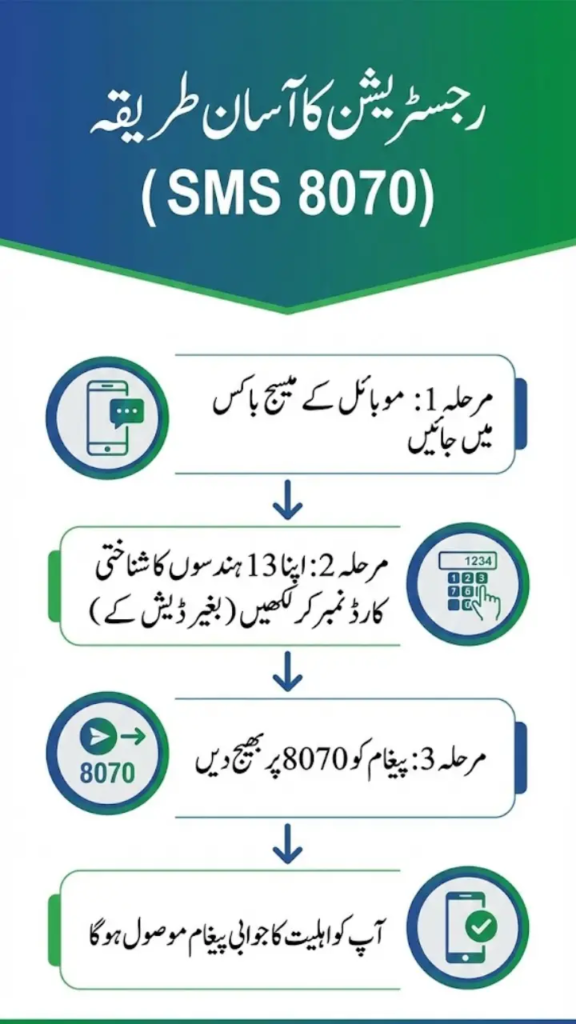
Register via the official PSER portal at pser.punjab.gov.pk (enter CNIC and details), or send your 13-digit CNIC to 8070 via SMS for eligibility check/registration. You can also register at the local Union Council or Municipal offices.
How can I register for the Ramazan package in the Punjab government?
Online: Visit pser.punjab.gov.pk, click register, provide CNIC, mobile number (via OTP), and household details. SMS: Send CNIC to 8070. Offline: Visit the nearest Union Council/Municipal office. Registration is mandatory for the Nigehban Ramzan Package.
What is the Maryam Nawaz 5000 rupees scheme?
This likely refers to earlier or related monthly assistance under the Maryam Nawaz Rashan Card (previously around Rs 3,000–5,000 monthly for ration). It has been increased to Rs 10,000 during Ramzan for eligible holders (e.g., low-income families, laborers). It’s part of broader relief like the Nigehban package.
What is the last date for the Ramzan package 2026?
The last date for registration (PSER survey/Nigehban Ramzan Package) was February 2026. (For current or future years, check pser.punjab.gov.pk or official announcements, as deadlines vary annually.)
What is the 8070 Ramzan package?
The 8070 Ramzan package is the Punjab government’s relief initiative (often called Nigehban Ramzan Package). Eligible families send their CNIC to 8070 via SMS for registration/check. It provides cash (e.g., Rs 10,000) and/or free ration (muft rashan) to low-income households during Ramzan.
What is the Ramazan 10000 package?
This refers to the Nigehban Ramzan Package under CM Maryam Nawaz, providing Rs 10,000 cash assistance to around 4.2 million deserving families (monthly income typically below Rs 45,000). It includes Nigehban Cards for cash/ration, plus other support like free iftar at Dastarkhwan centers. Rashan cardholders also get Rs 10,000 during Ramzan (up from regular amounts).
For the most accurate and up-to-date info, visit pser.punjab.gov.pk, send CNIC to 8070, or call the helpline (e.g., 0800-02345). Eligibility often requires Punjab residency and low income.
Conclusion:
The Nigehban Ramzan Package 2026, in its ambition and digital design, signifies a watershed moment for social protection in Pakistan. It moves beyond temporary aid toward a systematic, data-empowered framework for equity. By prioritizing the Punjab Socio-Economic Registry, it seeks to replace discretion and distortion with transparency and targeting. The Nigehban Ramzan Card is not just a piece of plastic; it is a tool of autonomy, allowing the widow, the laborer, and the struggling parent to make their own decisions in the face of hardship.
However, the ultimate success of this Rs. 47 billion endeavor depends on two factors: the government’s efficient and corruption-free execution and the public’s awareness and vigilant participation. The information in this guide is a weapon against confusion and fraud. Share it in your community groups, explain it to your elderly neighbors, and post it on local mosque notice boards.
Final Thought: As we prepare for a month of fasting, prayer, and reflection, this program challenges us all to think about the meaning of community support. It begs the question: Once you have secured your own family’s essential needs through this package, how will you extend the spirit of Nigehban (the Guardian) to others in your circle who might have slipped through the cracks of the system? True relief is not just received; it is multiplied through shared responsibility and kindness.